
Independent homeowner field guide
Cold-Climate Heat Pump Buying Guide
A cold-climate label is a useful screen, not a house-specific design. Compare low-temperature capacity and efficiency with your load, backup strategy, and winter site conditions.
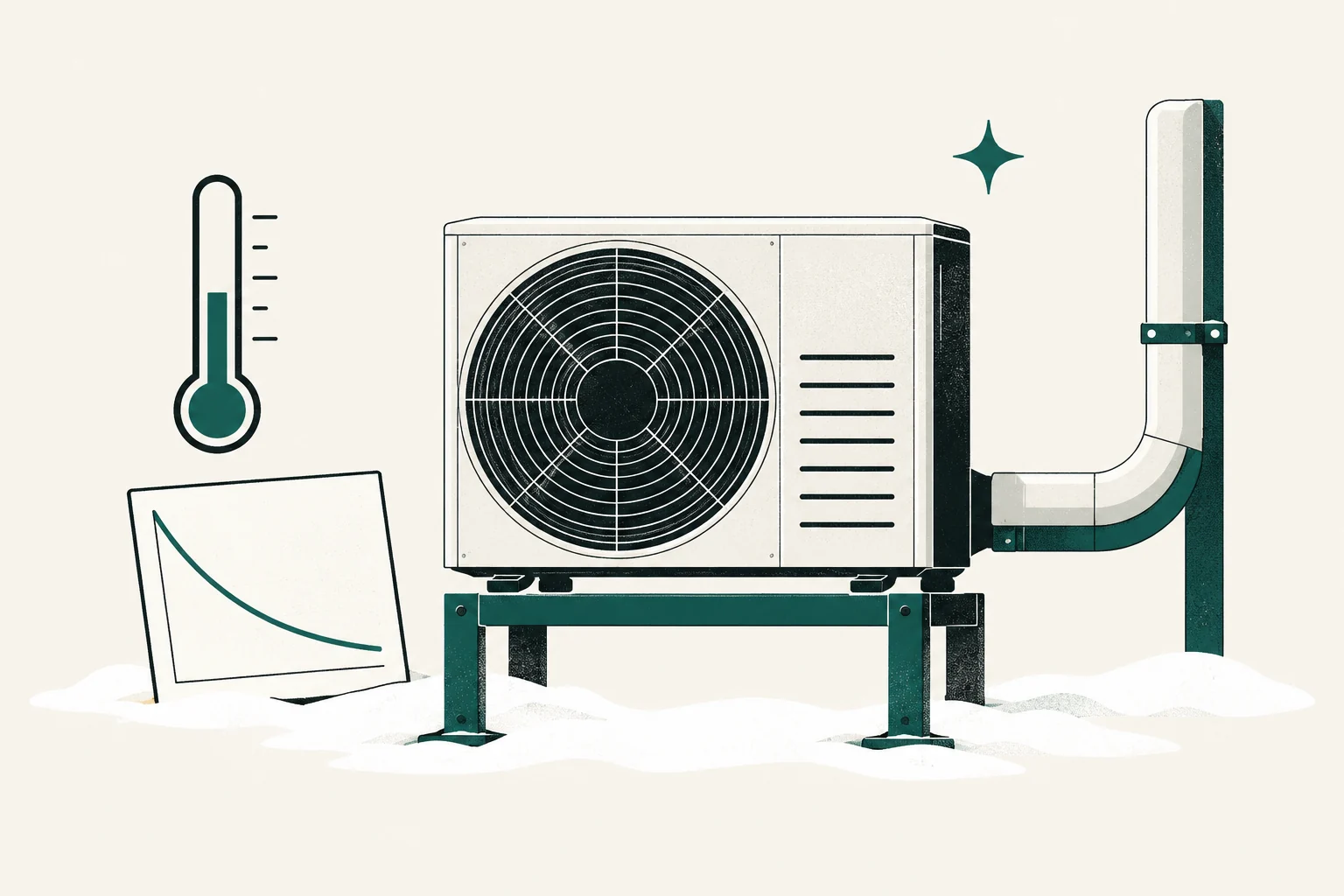
A cold-climate heat pump can keep delivering heat below freezing, but the badge alone does not tell you whether a model fits your home. The important comparison is between the house’s heating load and the heat pump’s available capacity and efficiency as outdoor temperature falls.
This cold-climate heat pump buying guide gives you the evidence to request before choosing equipment. It also covers backup heat, defrost, controls, snow, condensate, and commissioning—the details that a headline efficiency rating can hide.
Cold-climate heat pump buying guide: nine checks at a glance
| Check | Evidence to request |
|---|---|
| 1. Local design temperature | Weather/design condition used in the load calculation |
| 2. House heating load | Manual J or equivalent result and important inputs |
| 3. Equipment selection | Manual S or equivalent comparison with OEM data |
| 4. Low-temperature capacity | Maximum heating output at 47°F, 17°F, 5°F, and design temperature as available |
| 5. Low-temperature efficiency | COP at named temperatures and operating conditions |
| 6. Balance point | Load-versus-capacity graph and expected supplemental-heat hours |
| 7. Backup strategy | Type, size, stages, lockouts, fuel/electric assumptions |
| 8. Winter installation | Clearances, elevation, snow, ice, drainage, wind, roof runoff |
| 9. Commissioning | Measured startup and control-verification report |
1. Define “cold” for the project
Start with the outdoor heating design temperature used for the house, not a state average or the coldest temperature ever recorded. A design temperature is a statistical condition used for sizing; local codes and accepted design-data sources determine the appropriate value.
Then discuss resilience. If rare temperatures fall below design conditions, the system may use supplemental heat, allow a small indoor-temperature drift, or follow another documented plan. Make the trade-off explicit.
2. Calculate the house load
The heating load depends on insulation, windows, infiltration, geometry, orientation, and indoor/outdoor design conditions. A square-foot-per-ton rule cannot represent those factors.
Ask for the Manual J inputs and result. If you plan insulation or air-sealing work, calculate the post-improvement house when the project schedule supports it. ACCA describes Manual J as a fundamental step and warns homeowners against sizing from square footage alone (ACCA homeowner guidance).
Our heat pump sizing guide explains how Manual J and Manual S work together.
3. Compare the load with low-temperature capacity
Nominal tonnage usually describes a rating condition, not the heat delivered on your coldest design day. Request the manufacturer’s expanded performance table or submittal for the exact outdoor/indoor combination.
Plot or tabulate:
- the home’s heating load as outdoor temperature changes;
- the heat pump’s maximum capacity at the same temperatures;
- the heat pump’s minimum capacity, for variable equipment;
- the planned backup contribution.
The intersection of the home’s heating-load line and the heat pump’s maximum-capacity line is the capacity balance point. Below it, the home needs supplemental capacity or accepts temperature drift. DOE training uses this same load-versus-capacity relationship (Building Science Education cold-climate sizing).
4. Use the cold-climate designation correctly
ENERGY STAR’s cold-climate criteria provide a useful product screen. Current criteria include a COP of at least 1.75 at 5°F and at least 70% of the 47°F heating capacity retained at 5°F for the applicable test path (ENERGY STAR key product criteria).
Those values do not prove that the model covers your home’s design load. A model can meet the criteria and still be too small, too large at milder conditions, or poorly matched with its indoor unit.
Confirm the exact matched combination, not just a product-family brochure. Use the ENERGY STAR product listing, AHRI certificate where applicable, NEEP Cold Climate Air Source Heat Pump List, and manufacturer data as complementary sources.
5. Read COP beside capacity
Coefficient of performance (COP) compares heat delivered with electrical energy consumed at a specified operating condition. A COP of 2 means two units of heat are delivered for each unit of electricity used under that test condition.
COP changes with outdoor temperature, compressor speed, indoor conditions, and defrost. Ask for COP at 47°F, 17°F, 5°F, and the design temperature when data are available. Do not compare one model’s 47°F COP with another model’s 5°F COP.
SEER2 and HSPF2 remain useful seasonal ratings, but they do not replace a low-temperature capacity/COP table. Our SEER2, HSPF2, and COP guide explains how to use each number.
6. Decide how much backup heat is intentional
Backup heat is not automatically evidence of a failed heat-pump design. It can cover a limited number of extreme hours, support defrost, provide resilience, or allow the heat pump to be selected for better cooling and shoulder-season operation.
Ask the contractor to quantify:
- the capacity shortfall at design temperature;
- expected supplemental-energy or operating hours;
- the backup type and size;
- the control sequence and lockout settings;
- the effect on electrical service;
- the consequence if backup is unavailable.
PNNL’s cold-climate sizing guide reports metrics such as percent design load served, annual load served, hours requiring supplemental heat, and low-load cycling (Cold Climate Heat Pump Sizing Support Tools). These are more useful than a blanket “no backup needed” claim.
7. Check minimum capacity and mild-weather cycling
Cold-weather output matters, but so does the lowest output on a mild day. If a system cannot reduce capacity enough, it may cycle instead of modulating steadily. That can affect comfort, humidity, and efficiency.
Compare minimum and maximum capacity ranges with both heating and cooling loads. This is especially important when a unit is selected primarily for the winter load but the home has a modest cooling load.
Ask what happens in spring and fall, in small zones, and when several multi-zone heads are satisfied. Manual S and manufacturer data should inform the trade-off.
8. Understand defrost and control behavior
An air-source heat pump may periodically reverse operation to remove frost from the outdoor coil. Normal defrost can create outdoor vapor, water, and a temporary indoor-air change. Persistent heavy ice, repeated faults, or frozen drainage paths are not normal.
Ask:
- how the system detects and manages defrost;
- whether backup heat tempers indoor air during defrost;
- how auxiliary heat is staged and locked out;
- whether controls are proprietary/communicating;
- what happens after a power or internet outage;
- which settings the homeowner should not alter.
For dual fuel, distinguish the capacity balance point from an economic balance point, which depends on electricity price, fuel price, and equipment efficiencies. Read our dual-fuel heat pump guide before setting a switchover temperature.
9. Design the outdoor location for winter
The outdoor unit needs the manufacturer’s clearances and a site-specific snow and water plan. The proposal should address:
- expected snow depth and drifting;
- elevation above grade or a platform;
- roof snow, icicles, and gutter discharge;
- defrost-water drainage and refreezing;
- wind exposure and recirculation risk;
- service access in winter;
- noise and vibration near bedrooms or neighbors;
- protection that does not obstruct airflow.
Do not enclose the unit or improvise a cover without manufacturer approval. Plan where defrost water goes before the first freeze.
Ducts and indoor units still control comfort
A strong low-temperature compressor cannot overcome restrictive or leaky ducts. Ask for airflow, static pressure, return-air, sealing, and insulation findings. For ductless systems, require a room-by-room plan for closed bedrooms and remote spaces.
ENERGY STAR states that poor airflow and duct problems can reduce comfort and performance (HVAC quality installation). Compare ducted and ductless heat pumps by actual house fit.
Commission the system you bought
The final report should identify models and settings and document applicable airflow, refrigerant procedure, drainage, thermostat, auxiliary heat, defrost controls, and operating-mode checks. A cold-climate product can still underperform when charge, airflow, sensors, or controls are wrong.
Use our commissioning checklist before final closeout.
Questions for every cold-climate proposal
- What design temperature and indoor setpoint did you use?
- What is the calculated heating load?
- What capacity and COP does this exact combination deliver at 17°F, 5°F, and design temperature?
- Where is the capacity balance point?
- What share of the annual load and design load does the heat pump serve?
- What backup runs below the balance point, and how is it controlled?
- What is the minimum capacity in mild weather?
- How are defrost water, snow, and service access handled?
- Which commissioning results will I receive?
The buying rule
Buy a documented system, not a cold-climate adjective. The best-fit proposal connects a credible house load with exact matched-system data, explains backup and mild-weather trade-offs, and designs the installation for winter water, snow, controls, and service.
Source notes
- ENERGY STAR heat pump key criteria — current cold-climate COP and retained-capacity criteria.
- DOE/PNNL cold-climate sizing problem set — load/capacity lines and balance point.
- PNNL cold-climate sizing support tools — sizing metrics and definitions.
- ACCA homeowner guidance — Manual J and quality installation.
- ENERGY STAR HVAC quality installation — airflow and duct checks.
Continue by topic
Category
Topics
Local service handoff
Ready to discuss your heat-pump project?
Speak with a local service contractor about installation scope, site conditions, and next steps.
Call (877) 514-6658Heat Pump Installation Experts is a free service that helps homeowners connect with local service contractors. Contractors are independent; Heat Pump Installation Experts does not warrant or guarantee their work. Homeowners are responsible for verifying that any contractor they hire has the licenses and insurance required for the work. People shown in photos or videos on this site are actors or models unless explicitly identified otherwise; they are not contractors listed through this service.