
Independent homeowner field guide
Dual-Fuel Heat Pump Guide: Controls, Costs, and House Fit
Dual fuel pairs an electric heat pump with a fuel-fired furnace. The value depends on house loads, equipment matching, control logic, utility rates, and homeowner goals.
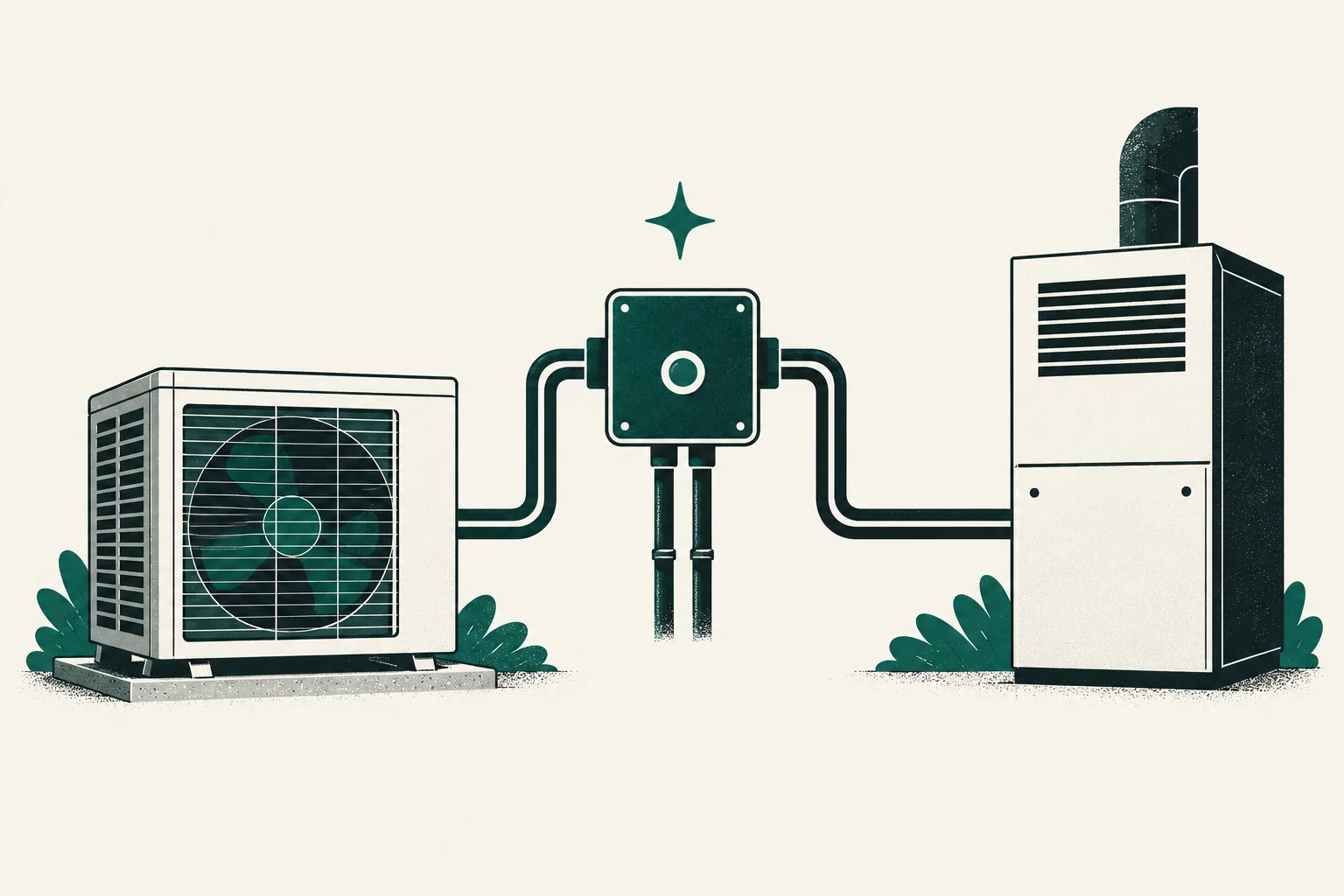
This dual-fuel heat pump guide covers systems that combine an electric heat pump with a fuel-fired furnace, usually through the same ducts. The heat pump handles cooling and some or most heating; the furnace takes over under defined conditions.
That sounds simple. The quality of the result depends on load calculations, matched equipment, fuel and electric rates, control logic, and a clear changeover strategy. A thermostat setting copied from another house is not a design.
Dual-fuel heat pump guide at a glance
| Question | What to establish |
|---|---|
| Can the house use shared ducts? | Airflow, static pressure, sealing, returns, filter and furnace/coil fit |
| How much heat can the pump deliver? | Capacity and COP at local temperatures |
| When does the furnace run? | Capacity, economics, emissions, comfort, or a combination |
| Can both run together? | Equipment and control sequence; many systems use exclusive changeover |
| What does it cost to operate? | Current delivered fuel price, electric rate, efficiencies, and climate hours |
| Who owns setup? | HVAC designer/installer documents final balance points, lockouts, and staging |
How a dual-fuel system works
In cooling, the heat pump operates like a central air conditioner. In heating, it transfers heat from outdoors until the controller decides to use the furnace. DOE describes hybrid systems as using the heat pump in milder weather and the furnace in colder conditions (DOE Heat Pump Systems).
Some configurations switch completely from compressor to furnace. Others have more nuanced sequences, but simultaneous operation must be specifically supported and designed. Do not assume equipment from different product families can be combined safely or retain every listed performance rating.
Houses that may benefit
Dual fuel can be worth evaluating when:
- a sound forced-air furnace and duct system already exist;
- the homeowner wants heat-pump cooling and shoulder-season heating without immediately removing fuel service;
- winter design loads or electrical-service constraints make all-electric backup costly;
- local rates make fuel competitive during some cold hours;
- resilience priorities favor two energy sources;
- the staged transition supports planned envelope or electrical upgrades.
It may be a poor fit when ducts need major reconstruction, the furnace is near end of life, fuel service has high fixed charges, combustion-safety issues remain, or the homeowner’s main goal is complete onsite fuel removal.
Calculate the load before keeping the furnace
Do not size the heat pump from the old furnace input or nameplate. Furnaces are often larger than the home’s current load, especially after window, insulation, or air-sealing upgrades.
Ask for a Manual J load calculation and Manual S equipment selection. ACCA explains that Manual S uses house loads, local climate, and manufacturer performance data rather than a one-size-fits-all rule (ACCA Manual S).
The design should show the heat pump’s capacity across outdoor temperatures and the furnace’s delivered output. Oversizing either component can create airflow, cycling, comfort, and control problems.
Capacity and economic balance points are not the same
The capacity balance point is the outdoor temperature where the home’s heating load and the heat pump’s maximum heating capacity meet. Below that point, the heat pump alone cannot cover the load.
The economic balance point is where the cost of useful heat from the heat pump and furnace is equal. It changes with electricity prices, fuel prices, heat-pump COP, furnace efficiency, and any rate structure.
Control guidance hosted by DOE notes that a capacity-based switch supports maximum heat-pump use, while an economic switch uses changing fuel and electricity costs (secondary-heating control guidance).
A third objective—lower operational emissions—can point to a different switch temperature depending on the electric grid and fuel. State the project priority instead of calling one setting universally “optimal.”
Estimate operating cost with the same unit of heat
Compare the cost per unit of delivered heat.
For electricity, a simplified comparison uses:
cost per delivered kWh of heat = electricity price per kWh ÷ heat-pump COP
For fuel, convert the delivered fuel price and furnace efficiency to the same heat unit. Include fixed fuel-service charges separately because they do not disappear when annual fuel consumption falls.
Use temperature-specific COP rather than one seasonal marketing number. Then apply local weather hours and rate tiers. A contractor or energy adviser can model the annual result; a single fuel-price ratio cannot capture the full season.
Equipment matching matters
The proposal should identify the outdoor unit, indoor coil, furnace, control, and any interface module by complete model number. Ask for:
- approved combination documentation;
- AHRI reference or certificate where applicable;
- cooling and heating performance for the combination;
- airflow ranges for both furnace and heat-pump modes;
- control compatibility and sensor requirements;
- manufacturer warranty implications.
An efficient outdoor unit does not guarantee the same rating with every coil and furnace. Likewise, a communicating variable-capacity heat pump may require proprietary controls.
Ducts must work for both heat sources
The shared duct system must deliver required airflow in cooling, heat-pump heating, and furnace heating. Ask for static-pressure measurements, filter pressure-drop review, return-air assessment, and room-level comfort findings.
ENERGY STAR notes that poor airflow can raise bills, reduce comfort, and shorten equipment life (HVAC quality installation). A hotter furnace supply does not prove the ducts will distribute lower-temperature heat-pump air comfortably.
If rooms feel drafty in heat-pump mode, the design may need airflow, register, duct, or control changes—not necessarily an earlier furnace takeover.
Controls decide the real-world outcome
The controller may use outdoor temperature, runtime, demand stages, utility signals, or proprietary logic. Your written control sequence should answer:
- What calls the furnace?
- Is the switchover fixed or adaptive?
- Can the furnace and compressor operate simultaneously?
- Which sensor supplies outdoor temperature, and what happens if it fails?
- Are compressor and furnace lockouts configured?
- How does recovery from a thermostat setback work?
- What happens during defrost?
- Which settings are homeowner-accessible?
Record the final settings at commissioning. Software updates, thermostat replacement, or a factory reset can change behavior later.
Comfort, emissions, and resilience trade-offs
Heat-pump supply air often feels cooler than furnace air while still heating the room. Longer, steadier runtimes can improve temperature stability. If occupants judge performance only by register temperature, they may force unnecessary furnace use.
Fuel combustion also brings venting, combustion-air, and carbon-monoxide safety responsibilities. Existing furnace and vent condition should be evaluated rather than treated as free backup.
Two energy sources may improve resilience in some outages or supply constraints, but most modern furnaces and heat pumps both require electricity for controls and blowers. Dual fuel is not automatically backup during a power outage.
Quote checklist
Require each bidder to state:
- Manual J heating and cooling loads.
- Heat-pump capacity and COP at relevant temperatures.
- Furnace input and delivered output.
- Capacity and proposed control balance points.
- Annual-cost assumptions and date of utility rates.
- Exact indoor/outdoor/furnace/control combination.
- Duct and filter corrections.
- Electrical, gas, venting, permit, and inspection scope.
- Commissioning measurements and final control-setting record.
Use the heat pump quote comparison checklist to normalize exclusions and warranty terms.
Commissioning checks specific to dual fuel
The installer should verify normal heat-pump heating, furnace heating, switchover logic, lockouts, sensor input, airflow, defrost interaction, and fault behavior. Ask for the temperatures/settings and results in the startup report.
Do not ask for unsafe forced operation in unsuitable weather. The technician should follow manufacturer procedures and document any condition-dependent follow-up. Use the full commissioning and handoff checks to review the evidence.
Is dual fuel right for you?
Choose dual fuel when the retained furnace, ducts, controls, rates, and project goals form a documented system—not simply because “gas is better when it gets cold.” Modern cold-climate equipment may cover more of the load than older assumptions suggest; at the same time, local rate structures or service constraints can make a hybrid plan reasonable.
Ask the designer to show at least two scenarios: the proposed changeover and a heat-pump-forward alternative. Compare annual cost, fixed charges, expected fuel use, electrical scope, emissions objective, and equipment replacement timeline. That makes the decision auditable when prices or priorities change.
Source notes
- DOE Heat Pump Systems — dual-fuel overview.
- ACCA Manual S — climate/load/performance-based equipment selection.
- CEE controls guidance hosted by DOE — capacity and economic switchover concepts.
- ENERGY STAR HVAC quality installation — airflow and duct quality.
Continue by topic
Category
Topics
Local service handoff
Ready to discuss your heat-pump project?
Speak with a local service contractor about installation scope, site conditions, and next steps.
Call (877) 514-6658Heat Pump Installation Experts is a free service that helps homeowners connect with local service contractors. Contractors are independent; Heat Pump Installation Experts does not warrant or guarantee their work. Homeowners are responsible for verifying that any contractor they hire has the licenses and insurance required for the work. People shown in photos or videos on this site are actors or models unless explicitly identified otherwise; they are not contractors listed through this service.