
Independent homeowner field guide
Best Smart Controllers for Mini Splits: Compatibility Comes First
Smart mini-split controllers send infrared commands like the original remote. Verify the remote, line of sight, per-head cost, and feature limits first.
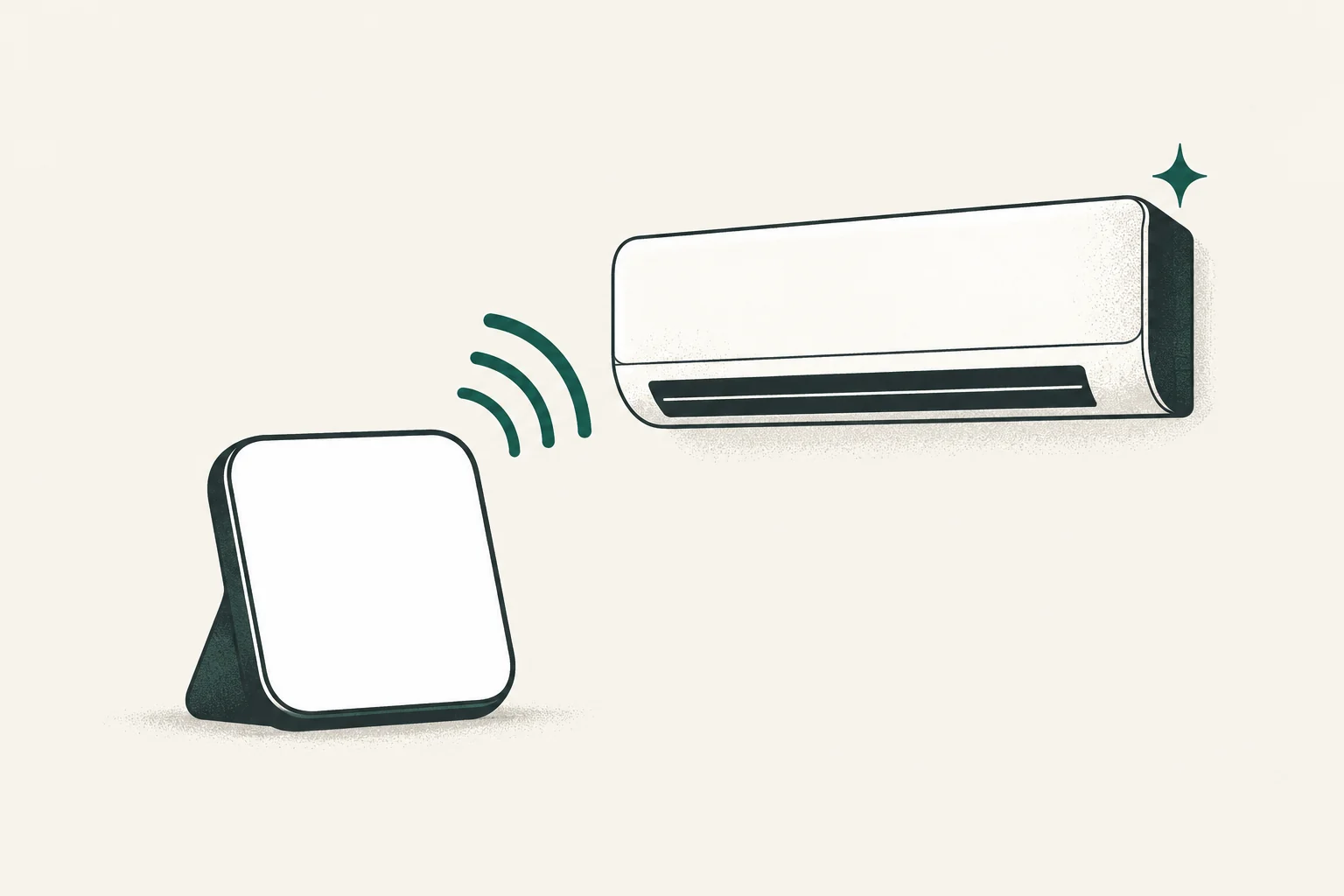
The best smart controllers for mini splits reproduce the important commands from your exact infrared remote, have a clear line of sight to the indoor head, and measure temperature where people actually spend time.
Our research shortlist is Sensibo Air Pro, Mysa for Mini-Splits, and Flair Puck. Sensibo is the most feature-rich single-room candidate, Mysa has the clearest no-subscription position, and Flair is the strongest fit when an on-wall dial or integration with a central thermostat matters.
Affiliate disclosure: We may earn a commission if you later buy through links added to this page. That does not change what we recommend or what you pay. Sensibo is an affiliate-program candidate, but no commercial link is currently active. We did not hands-on test these products.
Shortlist at a glance
| Controller | Best fit | Control method | Important limitation |
|---|---|---|---|
| Sensibo Air Pro | Rich sensing and automation for one IR-controlled head | IR, Wi-Fi, Bluetooth | Paid plan exists for some features; verify what remains free |
| Mysa for Mini-Splits | Buyers who want included smart features without a subscription | IR and Wi-Fi | Unsupported remote functions may still require the original remote |
| Flair Puck | Physical room control and central-thermostat integration | IR plus Wi-Fi/RF system | One Puck per head; Bridge may be preferred for multi-device setups |
These controllers do not wire into the refrigerant circuit and do not turn a mini-split into a conventional central HVAC system. They act like network-connected infrared remotes.
How we compared these controllers
We reviewed current manufacturer compatibility, control method, stated IR range, room sensing, smart-home support, subscription requirements, privacy disclosures, and the hardware needed per indoor head. We did not install or hands-on test the products, and the shortlist does not override each maker’s model/remote compatibility check.
Check compatibility before choosing a brand
Find the original handheld remote and confirm four things:
- It uses infrared, not radio frequency or Bluetooth.
- Its screen shows the full operating state: temperature, mode, and fan speed.
- The controller’s compatibility tool recognizes the remote or equipment model.
- The proposed mounting location has a clear line of sight to the indoor unit.
Mysa’s current incompatibility guidance says wired-controller-only systems, RF/Bluetooth remotes, and button-only remotes are not suitable. Flair likewise says its Puck sends IR and needs line of sight. Sensibo describes compatibility with air conditioners or heat pumps that use a remote control, but the exact remote should still be checked.
Save the original remote. Smart controllers may not reproduce specialty functions such as low-temperature freeze protection, vane patterns, quiet modes, self-cleaning, or manufacturer service commands.
1. Sensibo Air Pro: best for sensing and automation
Sensibo Air Pro’s official specifications list IR control, temperature, humidity, total volatile organic compound (TVOC), and estimated carbon-dioxide sensing. Sensibo states a line-of-sight range up to 20 feet and support for split, cassette, window, portable, and some central remote-controlled units.
Why it stands out
- Temperature and humidity sensing at the controller location.
- Additional air-quality indicators in one device.
- App, web, Alexa, Google Home, and Siri Shortcuts support.
- Broad claimed compatibility with remote-controlled equipment.
- Public affiliate program with a stated 25% hardware commission and 60-day cookie, subject to approval and current terms.
Limitations
- Some enhanced functions are associated with a Sensibo paid plan; verify the current feature split before purchase.
- TVOC and estimated CO₂ readings are not a substitute for safety alarms or professional indoor-air-quality assessment.
- Cloud-connected automations depend on service and network availability.
- One controller is generally needed for each independently controlled indoor head.
Choose Air Pro when room sensing and automation breadth matter more than avoiding every optional subscription. Its affiliate status should never override compatibility or cost-per-head analysis.
2. Mysa for Mini-Splits: best no-subscription option
Mysa states that its mini-split controller includes app control, scheduling, energy insights, and smart-home integrations without a subscription. It learns IR commands from the original remote and requires clear line of sight.
Why it stands out
- Explicit no-subscription policy for current smart features.
- App scheduling and remote control.
- Google Home, Amazon Alexa, and Apple HomeKit support.
- Clear public incompatibility documentation.
- Mysa states that it does not sell customer data; read the full policy for details and changes.
Limitations
- It cannot control wired-only, RF, or Bluetooth systems.
- Mysa lists several original-remote functions that may not be reproduced.
- Each indoor head needs its own control path.
- Energy insights from controller behavior are not the same as revenue-grade electrical metering.
Choose Mysa when subscription avoidance and Apple Home integration matter, after the exact remote passes compatibility review.
3. Flair Puck: best physical controller and hybrid integration
Flair Puck is the only shortlist product built around a rotatable wall control. Flair says its IR database covers more than 200 brands and that the Puck’s Room Sense function can control based on temperature at the Puck rather than at the indoor head.
Flair also offers Mirror Mode, which can follow an integrated central smart thermostat. That can suit additions or mixed homes where a mini-split complements a central system.
Why it stands out
- Physical dial control without opening an app.
- Room-based temperature sensing.
- Integration with several major smart-thermostat brands.
- Multi-head architecture with Bridge and Puck options.
- Home/away, scheduling, and voice control.
Limitations
- Flair says one Puck is required per indoor head.
- The Puck needs a direct IR path, with a stated range around 15 feet.
- Multi-device setups may benefit from or require additional gateway hardware.
- Some hybrid/staged-heating functions belong to Pro products; verify the package and ongoing terms.
Choose Flair when occupants need a familiar wall control or the mini-split must coordinate with a supported central thermostat.
Why IR control can drift out of sync
Many mini-split remotes transmit a complete state—mode, setpoint, fan, and sometimes vane position—in one IR command. A smart controller imitates that behavior.
If someone uses the original remote while the smart controller does not see the command, the app’s state can differ from the indoor unit. Power outages, blocked IR paths, and unsupported commands can create similar mismatches.
Reduce this risk by:
- choosing one primary control method;
- mounting the controller within the stated range and line of sight;
- keeping the original remote for specialty and recovery functions;
- testing heat, cool, auto, dry, fan, setpoint, and power commands; and
- confirming behavior after internet and power interruptions.
Placement matters more than it seems
The controller should sense the occupied zone, not the warm air trapped near the ceiling or a cold exterior wall. Avoid direct supply airflow, sun, kitchens, exterior doors, and electronics that add heat.
The position must still satisfy the IR path requirement. If comfort and line of sight conflict, do not hide the controller and hope. Choose a different wall, use approved mounting options, or ask the manufacturer about the exact room layout.
Multi-zone cost and control
A multi-zone outdoor unit with four indoor heads usually needs four smart controllers if each head needs independent IR control. Compare the full-system cost, Wi-Fi coverage, outlets, accounts, and mounting—not the price of one device.
Also ask whether the manufacturer offers its own wired or Wi-Fi interface. A native control may provide more reliable two-way status and preserve specialty functions, though it may cost more or require professional installation.
Privacy and subscription checklist
Before connecting a controller, review:
- data collected from temperature, occupancy, air-quality, and location features;
- whether geofencing stays on-device or uses cloud services;
- account deletion and data-export options;
- third-party voice-assistant sharing;
- which features need a paid plan; and
- what happens if the company’s cloud service is unavailable.
Sensibo’s June 17, 2026 privacy policy describes account, device, app, and subscription information collection and California privacy rights. Policies change, so use the version shown during setup.
Installation and testing checklist
- [ ] Photograph the indoor-unit and remote model numbers.
- [ ] Complete the maker’s compatibility check.
- [ ] Confirm 2.4 GHz Wi-Fi availability if required.
- [ ] Place the controller within the stated IR range and line of sight.
- [ ] Test every mode you regularly use.
- [ ] Test operation after manually using the original remote.
- [ ] Check behavior after internet and power interruptions.
- [ ] Review privacy, subscription, and account-recovery terms.
- [ ] Keep the original remote and installation records.
Bottom line
Verify the original remote before choosing a controller, then price one controller per independently operated head. Compare the control architecture in the ducted-versus-ductless guide, use these conservative heat-pump scheduling principles to test automations, and preserve the cleaning schedule in the heat-pump maintenance guide. A smart controller does not replace any of those decisions.
Frequently asked questions
Can an ecobee or Nest control a ductless mini-split?
Usually not directly. Most wall-mounted mini-splits use proprietary or infrared controls, not ordinary 24V thermostat calls. Some systems offer manufacturer interfaces, but conversion can reduce modulation or functions.
Do I need one controller per head?
Generally yes when each head operates independently. Verify the product’s multi-zone architecture and whether a hub or bridge is also needed.
Does a smart controller make the mini-split more efficient?
Scheduling, occupancy logic, and a better room-temperature location can reduce waste in some homes. They cannot correct poor sizing, refrigerant problems, blocked airflow, or a bad installation.
Sources and editorial notes
- Sensibo Air Pro specifications, affiliate program, and privacy policy — support compatibility, sensors, integrations, public commercial terms, and privacy considerations.
- Mysa for Mini-Splits and incompatible systems — support subscription, smart-home, IR, placement, and remote-function limitations.
- Flair mini-split controls, compatibility, and communication guide — support per-head architecture, line of sight, range, integrations, and Bridge/Puck communication.
- Feature availability, plan terms, firmware, and compatible remotes change. Re-verify before commercial links are activated.
Continue by topic
Category
Topics
Local service handoff
Ready to discuss your heat-pump project?
Speak with a local service contractor about installation scope, site conditions, and next steps.
Call (877) 514-6658Heat Pump Installation Experts is a free service that helps homeowners connect with local service contractors. Contractors are independent; Heat Pump Installation Experts does not warrant or guarantee their work. Homeowners are responsible for verifying that any contractor they hire has the licenses and insurance required for the work. People shown in photos or videos on this site are actors or models unless explicitly identified otherwise; they are not contractors listed through this service.