
Independent homeowner field guide
Electrical Panel Requirements for a Heat Pump
A heat pump needs the right circuits and available electrical capacity, but an empty breaker space or a 100-amp label alone cannot decide whether you need a service upgrade.
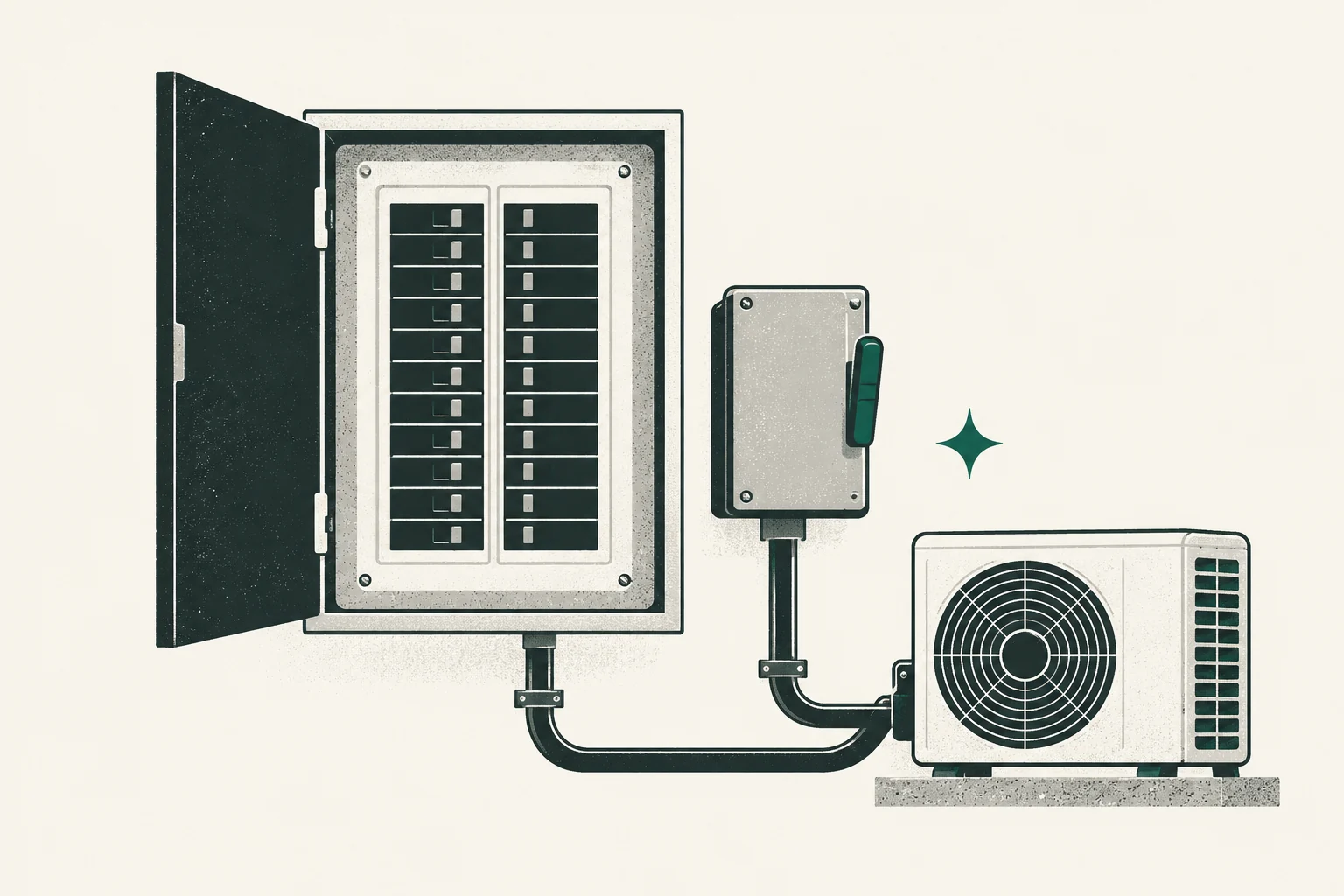
The electrical panel requirements for a heat pump depend on the actual equipment combination, the house’s existing loads, and local rules. The outdoor unit, indoor air handler, electric backup heat, and accessories may have separate circuits. A contractor cannot settle the question by looking only at the main-breaker number.
The right sequence is: choose equipment from the house loads, collect its electrical data, calculate the home’s service load, then design the circuits and permits. This guide helps you review that scope without turning panel work into a DIY project.
Safety boundary: Do not remove a panel cover, measure energized conductors, install a breaker, or change wiring based on this article. A qualified electrician and the local authority having jurisdiction decide the compliant installation.
Electrical panel requirements for a heat pump: four quote questions
- What loads are being added? Include the outdoor unit, air handler, backup heat, condensate equipment, and controls.
- Does the existing service have capacity? A code-based calculation or accepted measured-load method answers this—not breaker-space count alone.
- Can the existing distribution equipment accept the circuits? Panel condition, rating, listing, bus capacity, breaker compatibility, and physical spaces matter.
- What work and approvals are included? Identify circuits, disconnects, permits, inspections, utility work, and who performs each task.
Equipment size comes before electrical size
A larger heat pump and larger electric heat kit can create larger electrical requirements. That makes right-sizing an electrical-planning issue as well as a comfort issue.
Ask for the Manual J load result and Manual S equipment-selection basis before pricing major electrical upgrades. ACCA explains that Manual S uses the house loads, local conditions, and manufacturer performance data to select equipment (ACCA Manual S).
Do not reduce the heat pump size merely to fit an electrical assumption. Instead, have the HVAC designer and electrician compare capacity, backup strategy, equipment options, and service constraints together. Read our heat pump sizing guide for the mechanical side of that decision.
Panel spaces and service capacity are different
An electrical panel can have open spaces but insufficient service capacity. It can also have no convenient open spaces while the service has capacity and a compliant distribution solution is possible.
The Pacific Northwest National Laboratory’s electrical-panel calculator is based on National Electrical Code Article 220.83 and warns that its estimate does not replace evaluation by a licensed electrician (PNNL electrical panel calculator). A calculation considers existing fixed appliances and heating or cooling loads, not just the label on the main breaker.
The electrician should also examine:
- panel and service ratings;
- equipment condition and signs of damage;
- compatible breaker availability;
- conductor and feeder capacity;
- grounding and bonding relevant to the work;
- future loads such as an electric water heater, range, dryer, or vehicle charger;
- utility-side equipment and local upgrade requirements.
The nameplate drives circuit design
Request the exact model numbers and manufacturer electrical data before accepting a final electrical price. Common values include minimum circuit ampacity and maximum overcurrent protection, but the design professional must interpret them for the specific system and code edition.
Do not assume the heat pump’s rated heating capacity tells you the breaker size. Capacity is measured in Btu/h; electrical circuits are designed from the equipment’s electrical characteristics and installation instructions.
Variable-speed equipment may behave differently from older single-stage systems, but “inverter” does not mean “no electrical planning needed.” Each listed component still has installation requirements.
Backup heat can change the project
Electric resistance heat strips can be one of the largest added loads. The quote should state:
- the heat-kit model and output;
- installed stages;
- circuit arrangement;
- control and lockout strategy;
- the design condition or contingency it serves;
- whether a smaller or staged option was evaluated.
Backup heat should come from a documented comfort and capacity strategy. It should not be silently maximized “just in case,” because that can affect equipment cost, panel capacity, service work, and future operating bills.
Cold-climate performance data and the home’s design load can show when supplemental heat is expected. DOE’s cold-climate sizing resources define the capacity balance point as the intersection of the home’s load and the heat pump’s maximum capacity (PNNL cold-climate sizing tools).
Breakers, disconnects, and indoor components
Many split-system projects include more than one electrical feed. The proposal should identify power for:
- the outdoor unit;
- the air handler or indoor unit;
- electric backup heat, if separate;
- local disconnecting means;
- condensate pump or accessories, where required;
- controls, gateways, or crankcase-heater provisions built into the equipment.
The exact number, ratings, location, and conductor method depend on the equipment instructions and adopted code. Avoid generic internet breaker-size charts.
Ask who supplies each disconnect and whether the quoted price includes weatherproof equipment, service receptacles, surge protection, trenching, drywall access, labeling, and repair of finishes. A line reading “electrical by others” is not a complete electrical scope.
Panel replacement is not the same as a service upgrade
These project terms can describe different work:
- Circuit addition: New branch circuit and related devices within existing capacity.
- Subpanel: Added distribution spaces fed from existing equipment; it does not create utility-service capacity by itself.
- Panel replacement: Replacement of distribution equipment, sometimes without increasing service amperage.
- Service upgrade: Changes to service conductors, meter equipment, main disconnect, utility connection, and possibly utility infrastructure to increase capacity.
PNNL guidance notes that a subpanel may solve a space problem in some projects, but the existing service still requires evaluation (Building Science Education, electrical panel capacity). Your electrician and local authority determine what applies.
A panel upgrade is not automatically required for every 100-amp home
The service label is a starting fact, not a verdict. A smaller, efficient home with modest loads can differ greatly from a house with electric resistance heating, two vehicle chargers, a spa, and multiple large appliances.
Ask for the calculation and the inputs behind the recommendation. In some jurisdictions, an accepted measured-load method may inform capacity; in others, the permitting path or utility has specific requirements. Options such as equipment selection, staged backup heat, compliant load management, a panel change, or a full service upgrade must be evaluated for the actual home.
Avoid a contractor who guarantees “no panel upgrade” or “everyone needs 200 amps” before collecting equipment and household-load data.
Permits, inspections, and utility coordination
The quote should specify:
- who prepares the electrical design and load calculation;
- who pulls the electrical permit;
- whether the HVAC permit is separate;
- which inspections are included;
- whether utility approval, meter work, or a planned outage is needed;
- who repairs failed work or inspection comments;
- whether fees and finish repairs are included.
Rules vary by jurisdiction. Our permits and codes guide helps organize questions, but the local authority is the controlling source.
Electrical scope checklist for bids
| Quote line | Required detail |
|---|---|
| Equipment | Complete model numbers and manufacturer electrical data |
| Added load | Outdoor, indoor, backup heat, accessories |
| Capacity review | Method, inputs, result, person responsible |
| Panel work | Reuse, rearrange, replace, subpanel, or service upgrade |
| Circuits | Quantity, purpose, conductor route, finish/access assumptions |
| Protection | Breakers/overcurrent devices specified by design |
| Disconnects | Equipment, locations, weather rating where applicable |
| Permits | Filing, fees, inspections, corrections |
| Utility | Coordination, meter/service work, outage and lead time |
| Documentation | Labels, permits, inspection approval, updated panel schedule |
Use this table with the full heat pump quote comparison checklist.
Questions to ask the HVAC contractor and electrician
- Which exact equipment data did you use for the electrical scope?
- Does the backup-heat size come from the load and cold-weather capacity analysis?
- Is the problem circuit space, panel condition, service capacity, or all three?
- Which load-calculation or measured-load method will the authority accept?
- Are future electrification loads included or excluded?
- What utility work or lead time could change the schedule?
- Which walls, ceilings, or exterior surfaces may need access and repair?
- Will I receive the approved permit, inspection record, and revised circuit directory?
The practical decision rule
Do not approve a panel or service upgrade based only on tonnage, breaker spaces, or a main-breaker label. Require a traceable path from house loads to equipment, from equipment to electrical data, and from household loads to available service capacity.
That documentation makes electrical bids easier to compare and reduces the chance that an essential upgrade appears as a surprise after the HVAC equipment arrives. If surge protection appears in the bid, use the heat-pump surge-protector guide to ask about device type, voltage, listing, location, and installer responsibility without treating it as DIY work.
Source notes
- PNNL electrical panel calculator — NEC Article 220.83-based estimation and licensed-electrician disclaimer.
- Building Science Education: electrical panel capacity — retrofit panel-capacity concepts and subpanel distinction.
- ACCA Manual S — equipment selection using loads and performance data.
- PNNL cold-climate sizing support tools — balance-point and supplemental-heat concepts.
Continue by topic
Category
Topics
Local service handoff
Ready to discuss your heat-pump project?
Speak with a local service contractor about installation scope, site conditions, and next steps.
Call (877) 514-6658Heat Pump Installation Experts is a free service that helps homeowners connect with local service contractors. Contractors are independent; Heat Pump Installation Experts does not warrant or guarantee their work. Homeowners are responsible for verifying that any contractor they hire has the licenses and insurance required for the work. People shown in photos or videos on this site are actors or models unless explicitly identified otherwise; they are not contractors listed through this service.