
Independent homeowner field guide
Heat Pump Surge Protector Guide: What to Ask an Installer
A heat-pump surge protector must match the circuit, installation location, listing, enclosure, and manufacturer requirements. Installation is not a homeowner wiring project.
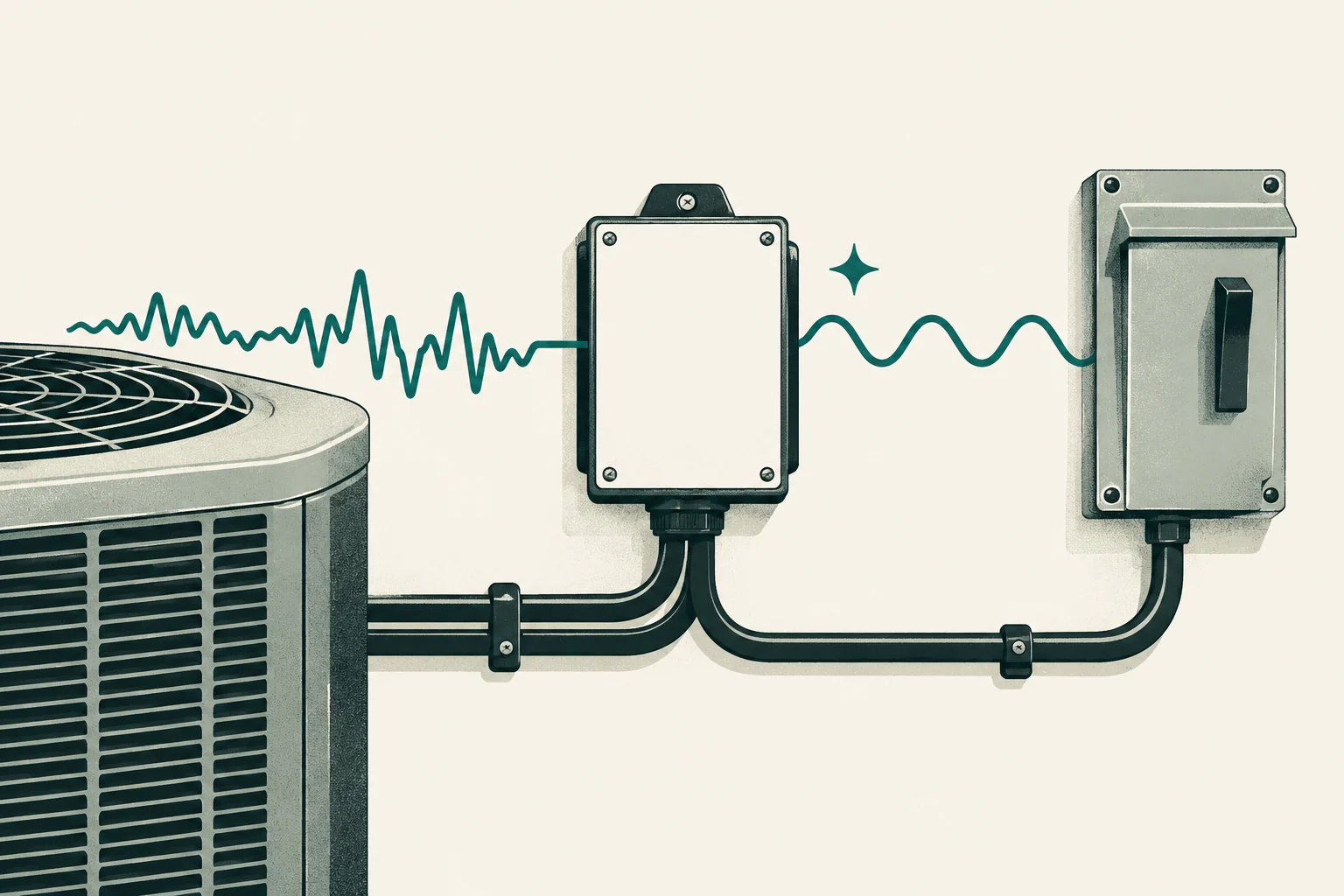
A heat pump contains compressor electronics, control boards, fan motors, sensors, and often inverter power electronics. A correctly selected surge protective device (SPD) can limit some damaging voltage transients, but it cannot stop every outage, sustained overvoltage, brownout, wiring fault, or direct lightning effect.
The useful question is not “Which box has the biggest joule number?” It is: What layered protection fits this electrical service, heat-pump circuit, equipment instructions, local code, and warranty?
Affiliate disclosure: We may earn a commission if purchase links are added later. That does not change what we recommend or what you pay. No affiliate links are currently active, and we did not hands-on test surge protectors.
The short answer
Ask a licensed electrician or qualified HVAC/electrical installer to consider two layers:
- A whole-home Type 1 or Type 2 SPD at or near the service equipment or panel.
- An equipment-level SPD approved for the heat pump’s voltage, phase, location, available fault current, and installation method.
Layering can address surge paths at the service and near sensitive equipment. It does not guarantee that equipment will survive every event.
Do not open the disconnect, panel, or outdoor unit to install an SPD yourself. These locations can remain hazardous even when a thermostat is off.
Whole-home and HVAC protection do different jobs
A whole-home SPD is installed at the service equipment or panel to divert transient energy before it spreads through branch circuits. An HVAC-specific device is installed near the heat-pump circuit or equipment under its listing and instructions.
One does not automatically replace the other. Conductor length, grounding and bonding, panel construction, circuit voltage, and installation location influence performance.
NIST’s consumer surge guide explains that electrical systems experience unavoidable transients from lightning and switching events. UL’s panelboard guidance distinguishes:
- Type 1 SPD: May be installed on the line or load side of the service overcurrent device when listed for that use.
- Type 2 SPD: Installed on the load side of the service overcurrent device, including at branch panels.
The electrician must decide which type and connection are permitted at the actual panel and service.
Seven ratings and markings to discuss
1. UL 1449 listing
Look for a complete listed surge protective device evaluated to UL 1449, not only a component or a vague “UL compliant” statement. UL Product iQ can verify manufacturers and model numbers.
2. SPD type
Type 1 and Type 2 describe where the device can be installed relative to the service disconnect. The label and installation instructions must match the proposed location.
3. Nominal system voltage
The SPD must match the circuit arrangement, such as a typical 120/240V single-phase residential service or the specific heat-pump circuit. Similar-looking devices may be designed for different voltage and phase systems.
4. Maximum continuous operating voltage
Maximum continuous operating voltage (MCOV) is the voltage that can remain across the SPD. It must suit the system and each protection mode.
5. Voltage protection rating
Voltage protection rating (VPR) is a standardized let-through measure used for comparison within the appropriate device class and mode. Lower is not automatically better if other ratings, circuit compatibility, or installation quality are wrong.
6. Nominal discharge current
Nominal discharge current (In) is a standardized endurance-related rating. Do not confuse it with a promise that the device will absorb any surge below that number.
7. Short-circuit current rating
The short-circuit current rating (SCCR) must be adequate for the available fault current at the installation point. This is an electrician/design check, not a retail guess.
Also verify an outdoor enclosure rating, operating-temperature range, status indication, replaceability, warranty terms, and whether the equipment manufacturer requires or prohibits a specific connection.
Why installation quality matters
An SPD diverts a transient through conductors. Long leads and unnecessary bends add impedance and can reduce protection. UL guidance for industrial applications likewise calls for conductors no longer than required and without needless bends.
That does not mean a homeowner should shorten wires. It means placement and conductor routing belong in the electrician’s scope.
Grounding and bonding also matter. An SPD cannot correct a missing grounding electrode, loose neutral, damaged service, or improper bonding. Ask the electrician to inspect the relevant system rather than treating the protector as a cure-all.
Surge protection is not voltage monitoring
A surge is a short transient. Other power problems last longer:
- sustained overvoltage;
- undervoltage or brownout;
- rapid cycling after an outage;
- phase loss or imbalance on applicable systems;
- generator transfer problems; and
- loose or failing connections.
Some HVAC protection products add voltage monitoring and restart delay. Those functions should be evaluated separately against the heat-pump manufacturer’s requirements. A compressor delay should coordinate with the thermostat and onboard controls, not fight them.
Ask these questions before approving a product
- Is the proposed unit listed to UL 1449, and can you show the exact listing/model?
- Is it Type 1 or Type 2, and why is that correct for this location?
- Does it match the service/circuit voltage and phase?
- What are the MCOV, VPR,
In, and SCCR values for the relevant modes? - Is the enclosure approved for the outdoor or wet location?
- Will it be installed at the service, panel, disconnect, equipment, or more than one point?
- Does the heat-pump manufacturer permit this connection?
- How will we know the device has failed or reached end of life?
- Are labor, replacement, and connected-equipment claims covered by the warranty?
- Will the permit or electrical inspection include this work?
The written proposal should name the manufacturer and model, not merely “surge protector included.”
How to compare retail listings safely
Lowe’s and Amazon are affiliate-program candidates only after an electrician specifies an acceptable model or a qualified editor verifies every electrical detail. A marketplace listing is not evidence that the product is suitable for a particular home.
Before any link is published, verify:
- current UL certification and exact catalog number;
- seller identity and product authenticity;
- voltage, phase, type, modes, MCOV, VPR,
In, and SCCR; - enclosure/environment rating;
- installation instructions and included overcurrent protection requirements;
- current warranty and replacement terms; and
- stock and revision consistency.
UL has issued warnings about products bearing unauthorized certification marks. Use the certification database rather than relying on a logo in a product photo.
What an SPD does not prove
Installing an SPD does not prove the heat pump has correct refrigerant charge, airflow, commissioning, load sizing, or wiring. It also does not guarantee an insurance or manufacturer claim will be paid.
Save the invoice, model/serial information, installation photos, permit, and status-indicator instructions with the heat-pump records. Check the indicator after major electrical events and during routine service.
Bottom line
Ask a qualified installer to coordinate protection with the actual circuit, listing, grounding, enclosure, and heat-pump instructions. Review the heat-pump electrical-panel requirements and the broader installation mistakes that affect electrical scope first, then use the contractor selection checklist to document who specifies, installs, and warrants the device.
Frequently asked questions
Does a heat pump need its own surge protector?
Manufacturers and local requirements differ. Equipment-level protection may add a useful layer, especially for inverter electronics, but a qualified professional should coordinate it with service-level protection and the equipment instructions.
Will a whole-house SPD protect the outdoor unit?
It can reduce some service-entering and internally generated transients, but no SPD blocks every event. Distance, wiring, grounding, surge path, and device ratings matter.
Is the highest kA number always best?
No. A large advertised surge-current value does not compensate for the wrong voltage, type, SCCR, enclosure, listing, or installation.
Sources and editorial notes
- NIST: Surges Happen! How to Protect the Appliances in Your Home — supports the general consumer explanation of unavoidable switching/lightning transients.
- UL Solutions: Panelboard Application Guide — supports Type 1 and Type 2 placement distinctions.
- UL Solutions: Verifying Surge Protection Devices — supports UL 1449, required markings, voltage, and nominal-discharge-current checks.
- UL Solutions: Product iQ surge database — supports independent model/listing verification.
- This article does not specify an electrical design. The authority having jurisdiction, equipment instructions, listing, and qualified installer control.
Continue by topic
Category
Topics
Local service handoff
Ready to discuss your heat-pump project?
Speak with a local service contractor about installation scope, site conditions, and next steps.
Call (877) 514-6658Heat Pump Installation Experts is a free service that helps homeowners connect with local service contractors. Contractors are independent; Heat Pump Installation Experts does not warrant or guarantee their work. Homeowners are responsible for verifying that any contractor they hire has the licenses and insurance required for the work. People shown in photos or videos on this site are actors or models unless explicitly identified otherwise; they are not contractors listed through this service.