
Independent homeowner field guide
Heat Pump Repair vs Replace: A Decision Guide Without the $5,000 Rule
Do not multiply age by repair cost and call it a decision. Compare a verified diagnosis with remaining system risk and the complete replacement scope.
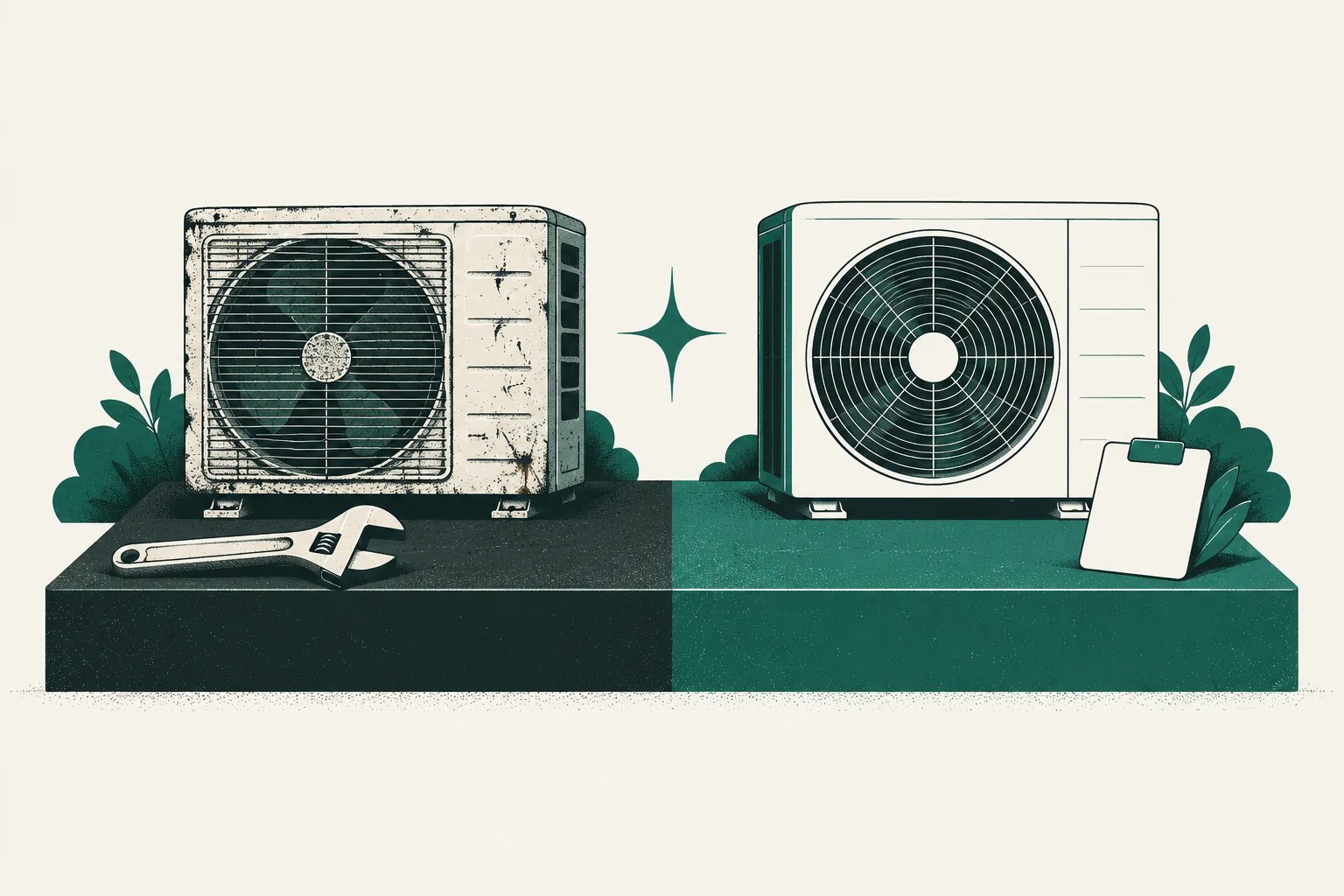
A heat pump repair vs replace decision should begin with a verified fault, not the age of the equipment multiplied by a repair estimate. The popular “$5,000 rule” has no universal technical or financial basis. It ignores climate, system type, warranty, refrigerant, utility rates, installation scope, and the cost of avoiding an emergency replacement.
Use a two-column comparison: the cost and risk of keeping this specific system versus the complete cost and expected result of replacing it correctly.
Start with a diagnosis, not a sales recommendation
Ask the technician to identify:
- the failed component and the evidence supporting the diagnosis;
- the root cause, if known;
- whether another defect could damage the repair;
- measured operating data before and after the proposed work;
- parts availability and lead time;
- parts and labor warranty on the repair; and
- any safety reason the system should remain off.
A failed capacitor, contactor, sensor, drain component, or motor can be a bounded repair. A compressor failure caused by poor airflow, contamination, incorrect charge, electrical damage, or an unmatched system requires a wider investigation.
Get a second diagnosis when the estimate is large, the explanation is vague, or replacement is proposed without measurements.
Decision matrix
| Factor | Leans toward repair | Leans toward replacement |
|---|---|---|
| Fault | Isolated, understood, available part | Compressor/coil plus unresolved root cause or multiple major failures |
| Repair history | First meaningful repair | Repeated failures or rising annual service cost |
| Warranty | Parts and/or labor still covered | Coverage expired or exclusions leave most cost to owner |
| Refrigerant | Serviceable system with available compatible parts | R-22 or an obsolete platform with high service/parts risk |
| Comfort | House was comfortable before fault | Persistent hot/cold rooms, humidity, noise, or capacity shortfall |
| Efficiency | Bills were stable for weather and rates | Documented poor performance after maintenance and controls checks |
| House changes | No major changes | Addition, envelope work, new ducts/zones, or load change requires redesign |
| Timing | Repair restores reliable service at bounded cost | Planned replacement avoids emergency premium or repeated downtime |
| Replacement scope | Requires major unrelated upgrades | New scope solves known ducts, electrical, controls, and comfort defects |
No single row decides the outcome. Weight the factors that affect safety, reliability, and long-term ownership cost.
Age is context, not a verdict
Older equipment has less remaining life on average, but chronological age does not reveal installation quality, climate duty, maintenance, corrosion, run hours, or prior repairs.
EPA recommends professional evaluation when HVAC equipment is more than 10 years old or no longer keeps the home comfortable. That is a prompt to evaluate—not a mandatory replacement date.
Ask for the manufacture date, installation date, model and serial numbers, warranty status, and service history. A 12-year-old system with one minor fault may be a better repair candidate than a six-year-old system with repeated refrigerant leaks and poor installation.
Refrigerant affects parts strategy
Identify the refrigerant on the nameplate. R-22 equipment can still be repaired; EPA does not require homeowners to replace it. New R-22 production/import ended, so service relies on reclaimed or previously produced refrigerant and compatible components.
For existing R-410A systems, EPA’s HFC transition guidance says homeowners may continue to maintain and repair equipment through its useful life. Compatible R-410A components can be used to service existing systems, while new systems move to lower-global-warming-potential refrigerants under current rules.
Do not “convert” a system by adding a different refrigerant. EPA notes that refrigerants and components are system-specific, and mildly flammable lower-GWP refrigerants cannot be placed in systems not designed for them.
Ask the contractor whether the proposed repair uses an exact compatible part, how future parts availability looks, and whether the replacement option uses a current refrigerant platform supported locally.
Separate parts warranty from real repair cost
A manufacturer parts warranty may not pay for diagnosis, labor, refrigerant, shipping, recovery, travel, or access. Confirm:
- remaining parts coverage by serial number;
- registration status and transfer rules;
- labor coverage from installer or third party;
- shipping/processing charges;
- whether a failed part must be returned; and
- whether the repair changes remaining coverage.
Compare the homeowner’s net repair cost, not the list price of the part.
Compare operating cost with measured inputs
Do not promise that replacement will “pay for itself” using a national percentage. Estimate with:
- actual annual electricity and fuel use;
- local current and time-of-use rates;
- weather-normalized consumption where available;
- existing backup-heat use;
- proposed equipment performance at local temperatures;
- duct losses and planned corrections; and
- expected use of heating and cooling.
An efficiency upgrade cannot deliver its rated result if the replacement is oversized, mismatched, poorly commissioned, or connected to restrictive/leaky ducts.
If high bills are the trigger, first rule out estimated utility bills, rate changes, thermostat/auxiliary settings, dirty filters, duct problems, envelope changes, and maintenance faults with the high electric-bill and auxiliary-heat guide.
Replacement must be a complete design
A replacement quote should not simply copy the old tonnage. Require a load calculation, equipment selection against heating and cooling loads, low-temperature capacity review, and duct/airflow assessment. Use the heat-pump sizing guide to compare that evidence without choosing tonnage yourself.
For split systems, request the AHRI certificate for the exact indoor/outdoor match. Include electrical work, permits, drain/line-set work, controls, backup heat, removal, startup, commissioning, and warranty registration.
The cheapest replacement bid can be more expensive if it omits the work that caused the old system’s problems.
Build a five-year comparison
Use a consistent horizon rather than an age-times-cost shortcut.
Keep and repair
Add:
- current repair;
- likely near-term repairs based on documented condition;
- maintenance;
- estimated energy/fuel;
- expected downtime or temporary-heat cost; and
- residual value at the end of the horizon.
Replace now
Add:
- complete installed price;
- financing cost;
- required electrical/duct/building work;
- maintenance;
- estimated energy/fuel;
- available verified rebates; and
- warranty value and exclusions.
Use a range for uncertain inputs. If the conclusion changes with a small assumption, the decision is close and nonfinancial factors—comfort, outage tolerance, noise, and timing—matter more.
Three sensible decision paths
Repair and monitor
Choose this when the fault is bounded, cost is proportionate, comfort was good, and the system has a credible service path. Create a replacement reserve and record baseline performance.
Repair as a bridge
Choose this when a modest repair can safely buy time for design, contractor comparison, weatherization, or incentive verification. Set a planning deadline before peak season.
Replace deliberately
Choose this when failures repeat, a major repair carries weak warranty, parts/refrigerant risk is high, comfort defects persist, or a well-designed replacement fixes multiple known problems.
Get local diagnostic help
If the system is down or the estimates conflict, seek a qualified local diagnosis. Before authorizing repair or replacement, ask the provider to document the diagnosis, complete scope, license and insurance where required, warranty, and permit responsibility.
Bottom line
Repair when the fault is bounded and the remaining system is credible; replace when repeated failures or unresolved comfort problems make the complete scope stronger. Compare that scope with the U.S. heat-pump installation cost guide and use the licensed-contractor checklist before authorizing either path.
Frequently asked questions
What is the $5,000 HVAC rule?
It multiplies equipment age by repair cost and suggests replacement above a threshold. It is a sales heuristic, not an engineering or financial standard, and this guide does not use it.
Should I replace an R-410A heat pump in 2026?
Not solely because it uses R-410A. EPA says existing systems can be maintained and repaired. Compare fault, compatible parts, total maintenance cost, efficiency, and remaining system condition.
Should indoor and outdoor units be replaced together?
For a new split system, use an AHRI-certified matched combination. A service replacement of one component may be possible on an existing system, but the contractor must verify compatibility and current EPA rules.
Sources and editorial notes
- U.S. EPA: Homeowners and Consumers FAQ — supports professional evaluation after 10 years, R-22 service facts, and Section 608 boundaries.
- U.S. EPA: HFC phasedown FAQ — supports continued repair of existing R-410A systems and current new-system transition context.
- AHRI: Air Conditioners and Heat Pumps — supports exact indoor/outdoor matching and certified reference numbers.
- ENERGY STAR: Replace or Repair — provides symptom context; it does not establish a universal dollar rule.
- This is general decision support, not a diagnosis or quote. Current EPA rules, equipment instructions, warranty terms, and local code control.
Continue by topic
Category
Topics
Local service handoff
Ready to discuss your heat-pump project?
Speak with a local service contractor about installation scope, site conditions, and next steps.
Call (877) 514-6658Heat Pump Installation Experts is a free service that helps homeowners connect with local service contractors. Contractors are independent; Heat Pump Installation Experts does not warrant or guarantee their work. Homeowners are responsible for verifying that any contractor they hire has the licenses and insurance required for the work. People shown in photos or videos on this site are actors or models unless explicitly identified otherwise; they are not contractors listed through this service.