
Independent homeowner field guide
Common Heat Pump Installation Mistakes—and the Evidence to Request
For each common heat-pump installation mistake, see what a homeowner may notice, why it matters, and which evidence a qualified installer should provide.
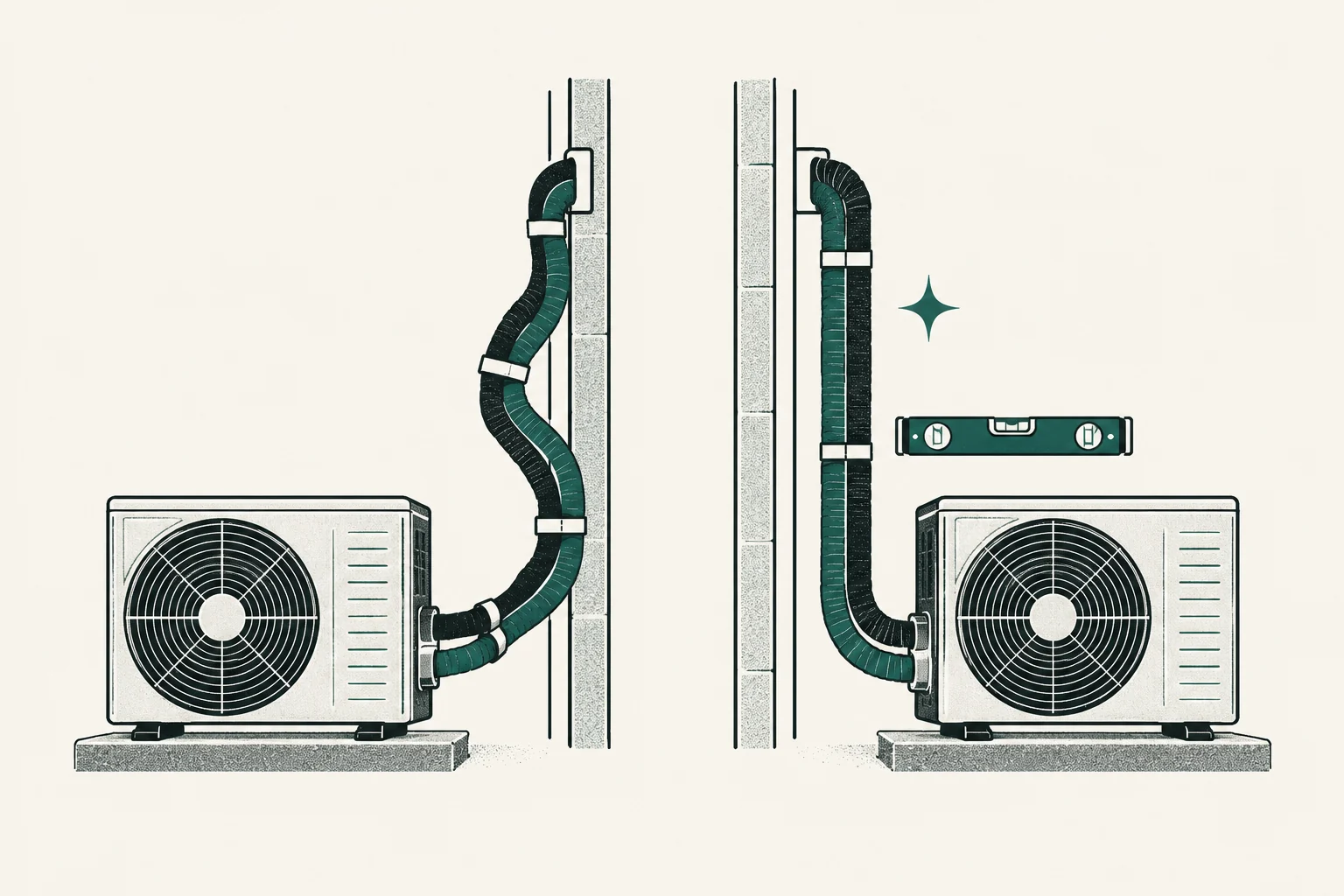
The most common heat pump installation mistakes are not always obvious on the day a system starts. Incorrect sizing, unsuitable ducts, weak drainage, control errors, and incomplete commissioning can appear later as uneven comfort, noise, high auxiliary-heat use, water damage, or repeated service calls.
Symptoms do not prove a particular cause. Use them to document a concern and ask a qualified professional for measurements. Do not open energized equipment or a refrigerant circuit to investigate.
The ENERGY STAR quality-installation guidance treats design, installation and verification as connected responsibilities.
Mistake 1: Sizing from square footage or the old nameplate
What a homeowner may notice: short cycling in mild weather, uneven rooms, noisy airflow, poor humidity control, or heavy backup-heat operation in cold weather.
Why it matters: floor area and existing tonnage do not capture insulation, windows, leakage, orientation, ducts, local design temperatures, or model-specific low-temperature capacity.
Prevention: require a room-by-room Manual J calculation and Manual S equipment selection. Review how heat-pump sizing works.
Evidence to request: load report, design temperatures, full model numbers, manufacturer capacity at relevant conditions, and backup-heat strategy.
Mistake 2: Treating nominal capacity as cold-weather capacity
What a homeowner may notice: the system heats well in mild weather but relies on auxiliary heat more than expected as temperatures fall.
Why it matters: air-source heat-pump capacity and efficiency change with outdoor conditions. Models sharing a nominal size can have different low-temperature performance.
Prevention: compare the house heating load with the selected model’s published capacity near the local winter design condition. Define the expected balance point and backup plan.
Evidence to request: manufacturer performance table or selection output, controls narrative, backup-heat capacity, and settings to be confirmed at commissioning.
The current ENERGY STAR air-source heat-pump page explains its cold-climate qualification and low-temperature testing context. Qualification supports comparison but does not replace house-specific selection.
Mistake 3: Ignoring the duct system
What a homeowner may notice: loud returns or registers, weak airflow in some rooms, doors moving, filter deformation, or comfort that never matched the proposal.
Why it matters: a new indoor unit may need different airflow than the previous system. Restrictive returns, small grilles, leaks, poor insulation, or crushed ducts can undermine delivered capacity.
Prevention: assess ducts during design, define repairs in the proposal, and verify airflow or external static pressure where applicable.
Evidence to request: duct findings, modification scope, filter specification, final blower settings, and recorded airflow/static-pressure measurements.
Mistake 4: Poor indoor-unit or ductless-head placement
What a homeowner may notice: drafts, temperature stratification, one head serving an open area poorly, blocked service access, or condensate routes that dominate the room.
Why it matters: ductless delivery depends on room load, air throw, obstructions, occupancy, ceiling height, and adjacent-space connections. A convenient wall is not automatically the right location.
Prevention: approve locations and routes before installation. Review room-by-room loads and the intended air path.
Evidence to request: marked locations, zone loads, connected-capacity information for multi-zone systems, and manufacturer clearance compliance.
Mistake 5: Reusing an unsuitable line set
What a homeowner may notice: often nothing visible at first. Later signs can include performance faults or service concerns, but those symptoms have many possible causes.
Why it matters: compatibility depends on manufacturer requirements, diameter, length, elevation, condition, cleanliness, prior refrigerant/oil, and routing.
Prevention: make line-set reuse or replacement an explicit design and proposal decision.
Evidence to request: line sizes and measured length, manufacturer allowance, condition/cleanliness procedure, and any required additional charge calculation. Refrigerant work belongs with EPA-certified technicians; see Section 608 certification.
Mistake 6: Incomplete evacuation, leak checks, or charge verification
What a homeowner may notice: insufficient heating or cooling, faults, icing, or excessive runtime. These signs do not prove incorrect charge.
Why it matters: moisture, non-condensables, leakage, or charge errors can impair operation and equipment life.
Prevention: follow the exact manufacturer procedure using qualified personnel and appropriate instruments.
Evidence to request: the completed startup record and the procedure/measurements the manufacturer requires. Do not ask for a generic target that may not apply to the equipment and conditions.
Mistake 7: Poor condensate or defrost-water planning
What a homeowner may notice: indoor leakage, stains, frequent pump operation, outdoor ice where people walk, erosion, or water entering the foundation area.
Why it matters: cooling produces indoor condensate, and heating-mode defrost can release substantial outdoor water at times. Climate and location affect freezing risk.
Prevention: plan slope, traps, pumps, insulation, overflow protection, termination, and outdoor drainage before placement.
Evidence to request: visible drain route, overflow response, startup drain test, safe outdoor discharge plan, and homeowner maintenance explanation.
Mistake 8: Underscoping electrical work
What a homeowner may notice: project delays, change orders, breaker trips, or an auxiliary-heat stage that cannot be installed as proposed.
Why it matters: compressor equipment, air handlers, backup heat, disconnects, controls, and panel/service capacity may create different requirements.
Prevention: inspect the electrical system during estimating, define each circuit and trade, and obtain required permits.
Evidence to request: nameplate-based circuit scope, load/service review where required, permit, inspection, and a written allowance for any genuinely concealed condition.
Repeated breaker trips are a stop-and-call symptom. Do not reset a breaker repeatedly or replace it with a different rating.
Mistake 9: Incorrect thermostat or control configuration
What a homeowner may notice: frequent auxiliary heat, failure to change stages, unexpected emergency-heat indication, poor dual-fuel changeover, or a smart thermostat that loses features.
Why it matters: controls coordinate compressor capacity, fan, backup heat, sensors, and sometimes defrost or proprietary communication. Compatibility is more than fitting wires to terminals.
Prevention: select the control with the equipment, document settings, and test operating modes.
Evidence to request: approved thermostat/control model, configuration record, staging or changeover explanation, and homeowner demonstration.
Mistake 10: Outdoor placement that ignores service, snow, water, or sound
What a homeowner may notice: blocked service panels, snow burial, roof runoff onto the unit, recurring ice, vibration in a bedroom, or conflict with a walkway.
Why it matters: manufacturer clearances, local requirements, climate, structure, and occupants all affect a durable location.
Prevention: approve a site plan that accounts for airflow, service, mounting, drainage, snow, flood, sound, and property constraints.
Evidence to request: manufacturer clearance check, support detail, drainage/snow approach, and required planning or permit approval.
Mistake 11: Skipping permits or final inspection
What a homeowner may notice: an open permit, no inspection record, or a future question during warranty, insurance, refinancing, or sale.
Why it matters: the AHJ determines local requirements. A contractor’s general statement is not a project-specific determination.
Prevention: confirm permits before work and closeout responsibilities in the contract. Read the permits and codes guide.
Evidence to request: issued permits, correction notices, and proof of final approval used in the jurisdiction.
Mistake 12: Calling startup “commissioning” without records
What a homeowner may notice: the system is turned on briefly, but no measurements, settings, or handoff documents are available.
Why it matters: a system can produce warm or cool air while airflow, charge procedure, controls, drainage, or backup heat remains unverified.
Prevention: define the commissioning checklist and deliverables before signing.
Evidence to request: recorded results for the applicable airflow, electrical, refrigerant, drain, control, operating-mode, and handoff checks. ACCA’s quality standards provide a useful framework.
Mistake 13: Incomplete warranty and homeowner handoff
What a homeowner may notice: no registration confirmation, missing model numbers, uncertainty about filters or settings, and confusion over who pays for labor.
Why it matters: parts and labor coverage differ, registration deadlines may apply, and undocumented settings make later service harder.
Prevention: use a closeout checklist before final payment.
Evidence to request: model/serial records, warranty registration, labor terms, permit/inspection closeout, commissioning report, manuals, filter details, and service contact.
If you suspect an installation problem
- Record the date, weather, thermostat settings, fault code, sound, room conditions, and utility-use change.
- Photograph visible conditions from a safe location without removing panels.
- Read the manual’s homeowner section and note any permitted basic check.
- Send the installer a concise written report and request measured diagnosis.
- Ask for the original load, selection, commissioning, and permit records.
- If the response remains unresolved, consider a qualified independent assessment appropriate to the issue.
Do not diagnose refrigerant charge, energized electrical components, combustion, or internal machinery yourself. Start with the complete heat-pump installation process, evaluate the contractor’s documented evidence, and use the installation-day and handoff guide to identify the promised closeout records. Use the safe maintenance checklist only for homeowner-safe tasks.
Choose the next investigation from the actual symptom
Keep the thirteen installation checks above, then describe the problem you actually observe. “Bedroom is cold with the door shut” is more useful than “the installer sized it wrong.” Note the room, date, outdoor conditions, control setting, display messages and any safe photos. Carrier’s troubleshooting guidance distinguishes basic owner checks from faults requiring service.
If heat is missing throughout the house, document the selected mode and safe external observations. If outdoor ice persists, record when it forms and whether it clears without chipping it away. For new vibration, record where it is heard and the operating conditions rather than removing a bracket. For a cool but humid house, note moisture sources and independent room readings if an adequate instrument is already available. These observations direct different investigations; none proves a refrigerant, load, airflow or mounting diagnosis.
For a recent installation, send the factual packet to the installer and reference the original commissioning and unresolved-item record. Ask what they checked, what they found and which next step or return visit is due. Preserve the earlier report rather than replacing it with a new summary. Unsafe electrical, combustion, refrigerant or water-damage symptoms require prompt professional or emergency action as appropriate, not another observation experiment.
Source notes
- ACCA Quality Standards — design, installation, and verification framework.
- ACCA Technical Manuals — Manual J, Manual S, and distribution methods.
- ENERGY STAR: Air-Source Heat Pumps — cold-climate performance and homeowner context.
- AHRI Directory — certified matched-system ratings.
- EPA Section 608 Technician Certification — refrigerant-work certification.
Continue by topic
Category
Topics
Commissioning, Ductwork, Electrical, Manual J, Manual S, Permits & Codes
Local service handoff
Ready to discuss your heat-pump project?
Speak with a local service contractor about installation scope, site conditions, and next steps.
Call (877) 514-6658Heat Pump Installation Experts is a free service that helps homeowners connect with local service contractors. Contractors are independent; Heat Pump Installation Experts does not warrant or guarantee their work. Homeowners are responsible for verifying that any contractor they hire has the licenses and insurance required for the work. People shown in photos or videos on this site are actors or models unless explicitly identified otherwise; they are not contractors listed through this service.